Adaptation & temporal coordination
Reusing learned behaviours when states, timing and interaction conditions change.
The question
A demonstrated motion is observed under one set of starting states, target states and timing conditions. During interaction, these conditions can change, and independently learned subsystems may need to reach their target states together.
The approach
My research uses the geometry of second-order latent dynamics to connect prescribed position–velocity states with execution time. An analytical timing relation supports admissible state-to-state adaptation and gives separately represented behaviours a common arrival-time requirement.
Behaviour–execution interface
Research focus
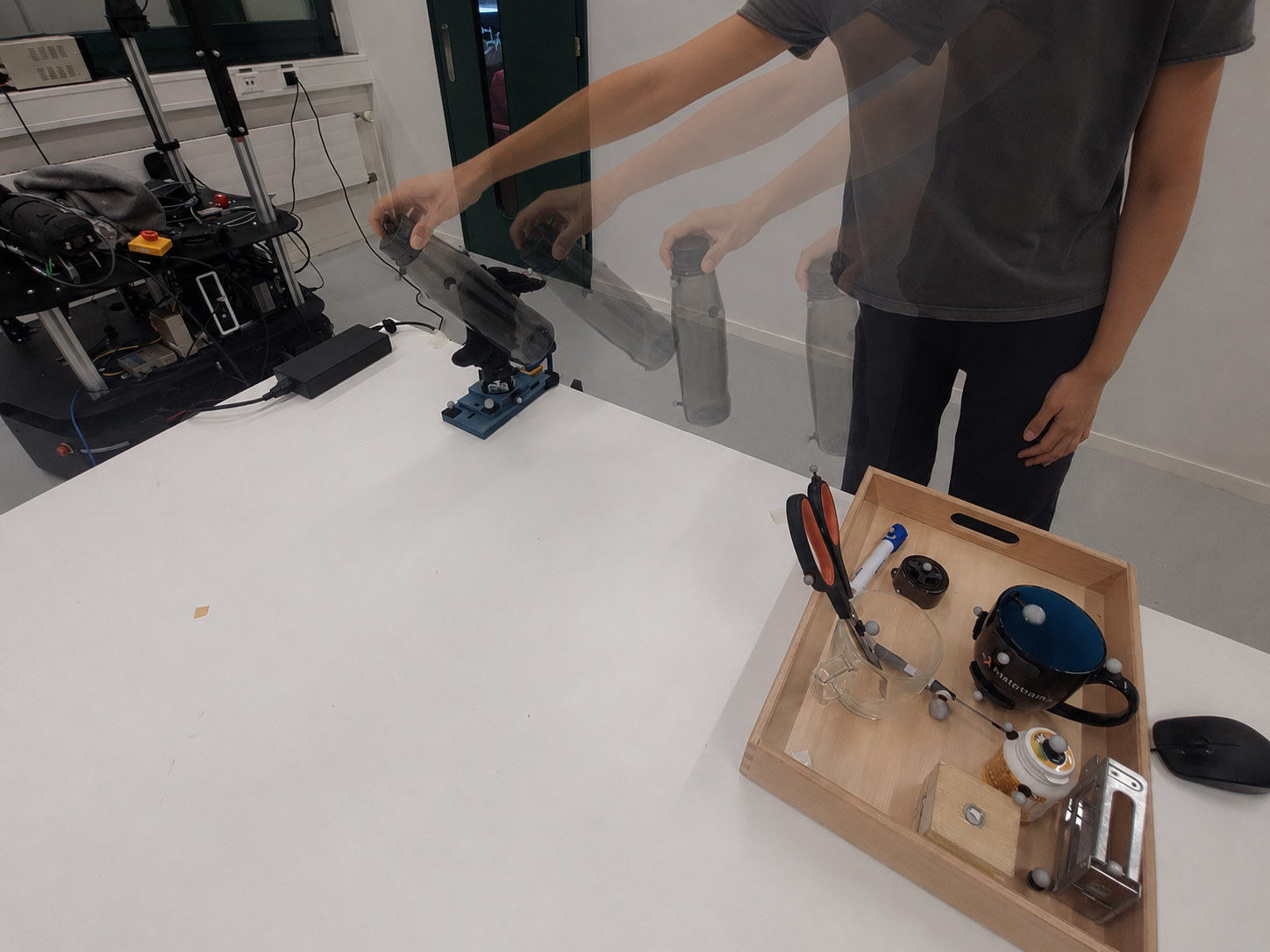
This research connects boundary-state adaptation, prescribed execution timing and temporal coordination within one geometry-grounded formulation. The experimental application considers online coordination of a dexterous hand with a human-held object.
Results & evidence
- Reuse of a hand behaviour learned from a single synchronised object–hand demonstration.
- Human-to-robot handover with a fixed-base Wuji hand controlled through its 20 actuated joints.
- Reactive adaptation to variation in the bottle’s path and timing, with the intended grasp established across the recorded handovers.
Scope & assumptions
The timing analysis concerns admissibility in the latent representation. A shared arrival time does not by itself impose continuous relative-pose constraints, collision avoidance, contact-force limits or bounds on physical acceleration and torque.