Learning from demonstration
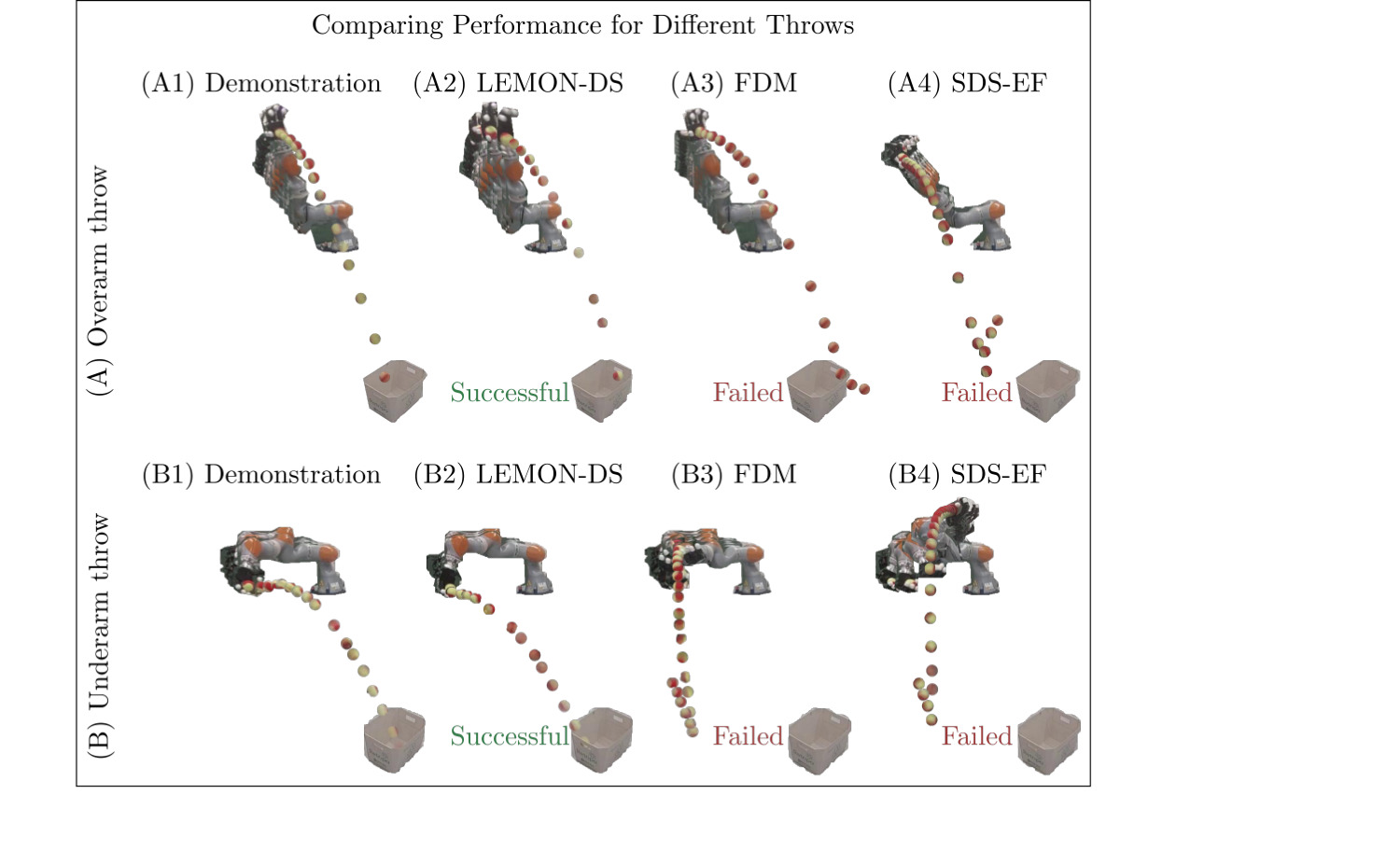
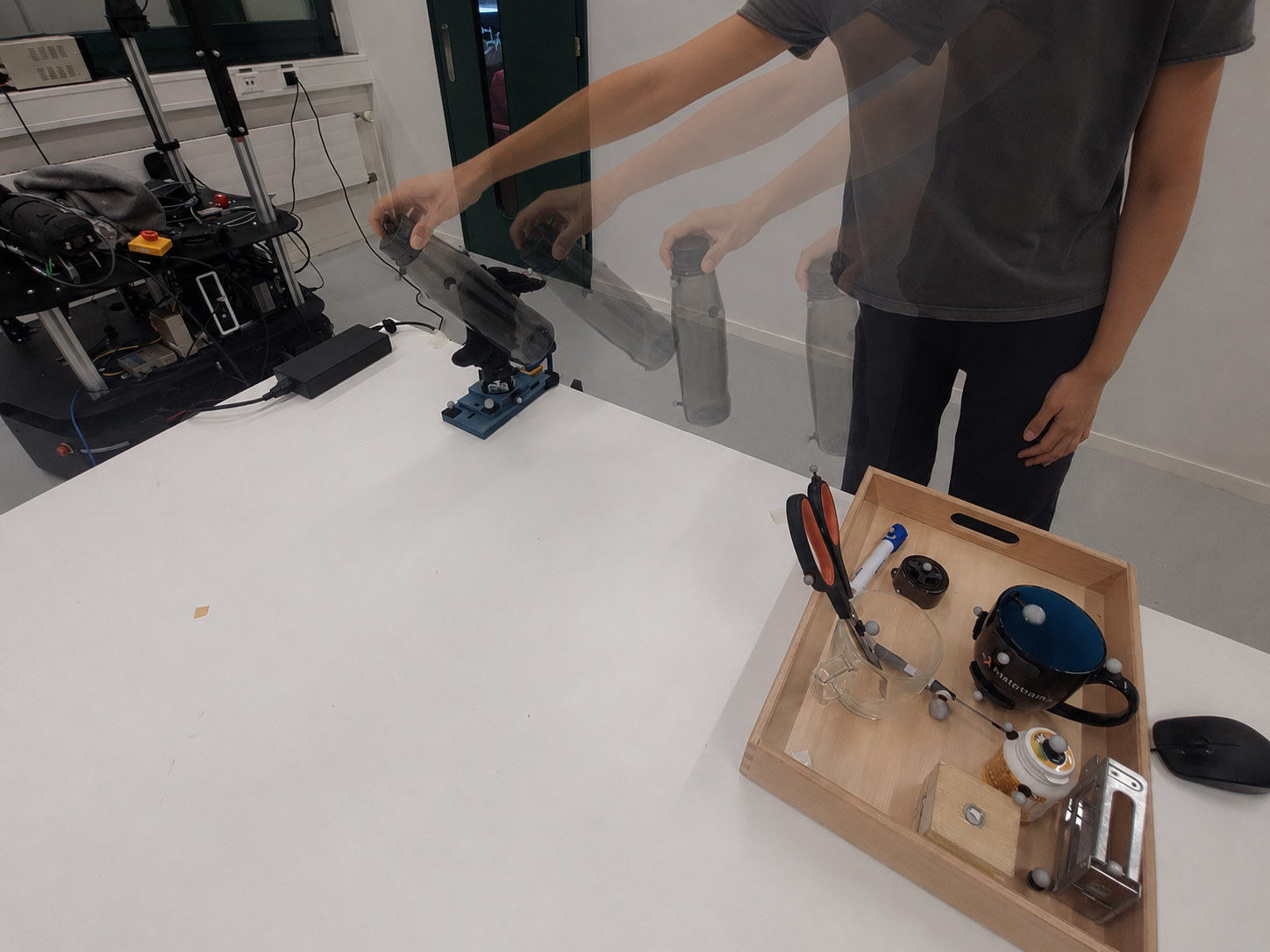
How can a robot learn stable, reactive behaviour from a single example?
Demonstration–behaviour interfaceI study how robots can learn from demonstration, transfer skills, and adapt—with analytical guarantees.
Doctoral researcher at LASA, EPFL, advised by Prof. Aude Billard. My work connects robot learning, geometry, and feedback control.
Four connected questions guide my work, from a user’s demonstration to execution across robots and changing conditions.
How can a robot learn stable, reactive behaviour from a single example?
Demonstration–behaviour interfaceHow can the same skill work on robots with different kinematics?
Behaviour–embodiment interfaceHow can learned behaviours adapt to new states and reach their goals together?
Behaviour–execution interfaceHow can task context guide the selection and adaptation of robot behaviour?
Context–behaviour interfaceFrom analytical structure to physical experiments. Explore the questions, contributions, and results behind the work.
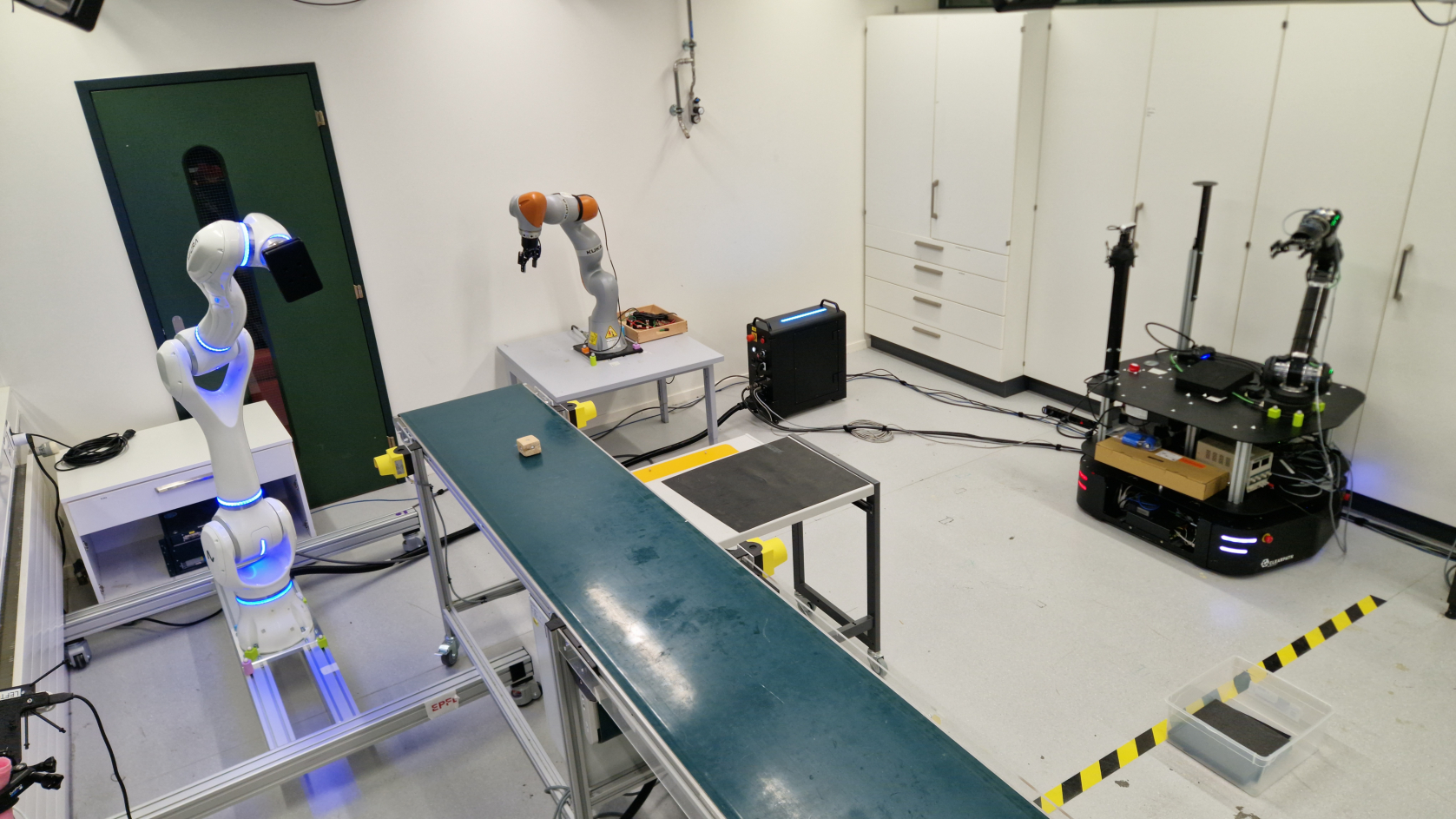
Teach a skill once. Execute it across different robots, with their kinematic constraints built into the control policy.
Adapt learned behaviours to new position–velocity states and timing requirements, and coordinate them through a shared arrival time.
Use language to interpret task context, select robot actions and tune how those actions are executed.
Science Robotics · 11(113), eaea1995
Reusing demonstrated workspace behaviour across robot embodiments with explicit kinematic grounding.
@article{gupta2026kinematic,
  title = {Demonstrate once, execute on many: Kinematic intelligence for cross-robot skill transfer},
  author = {Sthithpragya Gupta and Durgesh H. Salunkhe and Aude Billard},
  journal = {Science Robotics},
  year = {2026},
  doi = {10.1126/scirobotics.aea1995}
}IEEE Transactions on Robotics · 42, 1468–1484
A compact feedback policy learned from one high-dimensional demonstration, with global asymptotic stability.
@article{gupta2026lemon,
  title = {Compact One-Shot Modeling of High-Dimensional Demonstrations Using Laplacian Eigenmaps},
  author = {Sthithpragya Gupta and A. Nayak and Aude Billard},
  journal = {IEEE Transactions on Robotics},
  year = {2026},
  doi = {10.1109/TRO.2026.3666134}
}IEEE Robotics and Automation Letters · 10(12), 12509–12516
Analytical structure for understanding inverse-kinematic solutions in special classes of redundant manipulators.
@article{salunkhe2025cuspidal,
  title = {Cuspidal Redundant Robots: Classification of Infinitely Many IKS of Special Classes of 7R Robots},
  author = {Durgesh H. Salunkhe and Sthithpragya Gupta and Aude Billard},
  journal = {IEEE Robotics and Automation Letters},
  year = {2025},
  doi = {10.1109/LRA.2025.3623011}
}IEEE Robotics and Automation Letters · 9(11), 9407–9414
Grounding task context in structured robot plans and qualitative and quantitative action parameters.
@article{gupta2024contextualization,
  title = {Action Contextualization: Adaptive Task Planning and Action Tuning Using Large Language Models},
  author = {Sthithpragya Gupta and Kunpeng Yao and Loïc Niederhauser and Aude Billard},
  journal = {IEEE Robotics and Automation Letters},
  year = {2024},
  doi = {10.1109/LRA.2024.3460408}
}IEEE International Conference on Robotics and Automation · ICRA 2021
Configuration exploration for data-efficient acquisition of robot inverse dynamics.
@inproceedings{khadivar2021exploration,
  title = {Efficient Configuration Exploration in Inverse Dynamics Acquisition of Robotic Manipulators},
  author = {F. Khadivar and Sthithpragya Gupta and W. Amanhoud and Aude Billard},
  booktitle = {IEEE International Conference on Robotics and Automation},
  year = {2021},
  doi = {10.1109/ICRA48506.2021.9561587}
}Stories about Kinematic Intelligence and the research behind cross-robot skill transfer.
A closer look at Kinematic Intelligence, robot-specific constraints, and the experiments behind cross-robot skill transfer.
Read articleCoverage of the framework for reusing demonstrated skills across robots with different mechanical designs.
Read articleEPFL’s research story on teaching a task once and transferring its behaviours across a multi-robot assembly line.
Read articleI am a doctoral researcher in robotics at the Learning Algorithms and Systems Laboratory, EPFL, working with Prof. Aude Billard.
My research asks how a demonstration can become a reusable robot program. I develop structured representations and control methods that connect data-efficient learning with stability, kinematic feasibility, and adaptation.
My work spans mathematical analysis and implementation on physical robots, including serial manipulators and dexterous hands. Earlier projects include robot inverse dynamics and assistive robotic mechanisms.
Education & research experience
For research opportunities, collaborations, or a conversation about robot learning and control.