Transferring demonstrated behaviour across robots with different mechanical structures.
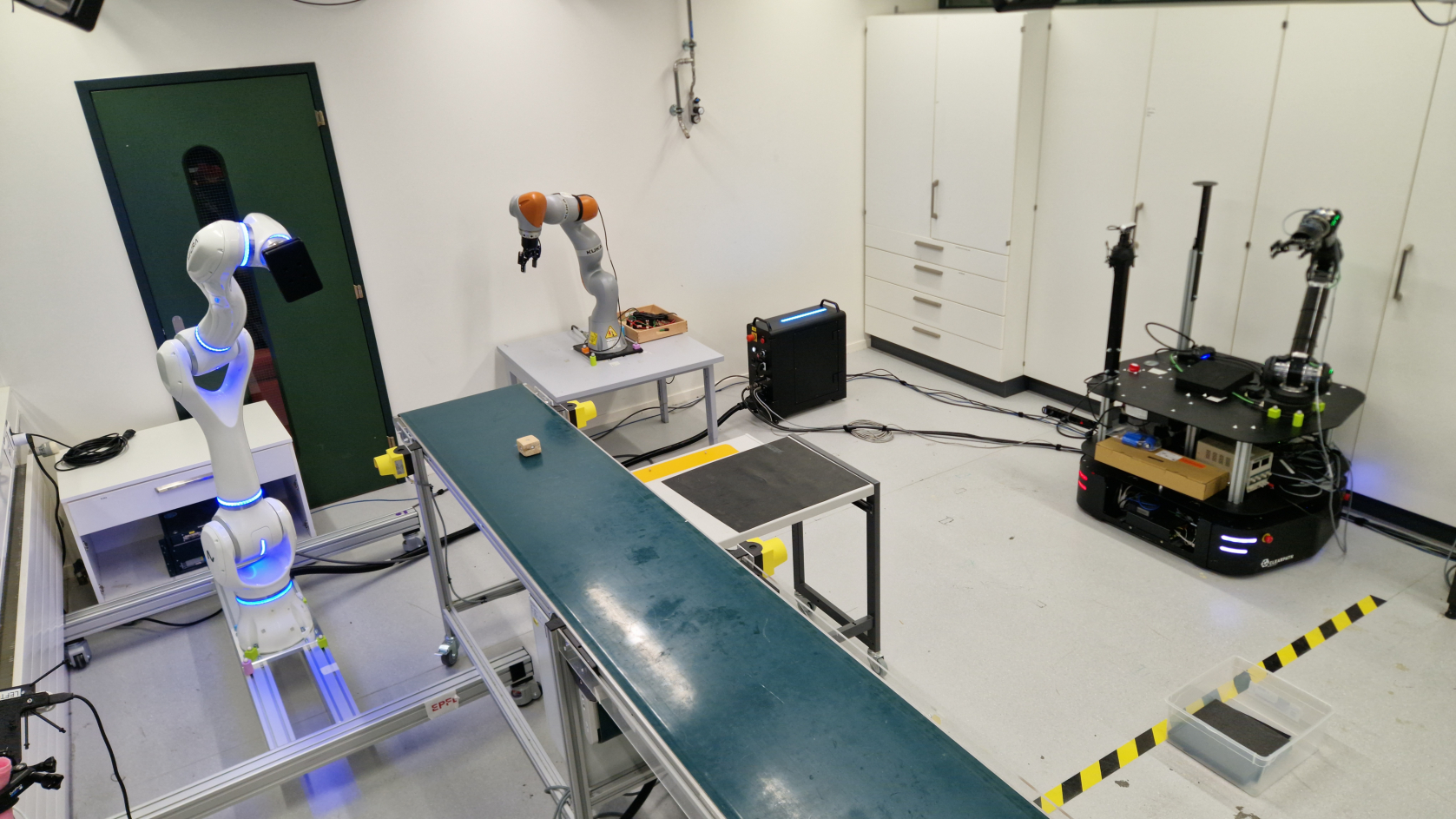
Cross-robot skill transfer in an assembly-line experiment with three commercial robot platforms. Research imagery: LASA, EPFL.
The question
A motion that works on one robot may encounter a joint limit or a singularity on another. Transferring a workspace skill therefore requires reasoning about how each robot can realise that motion in its own joint space.
The approach
Kinematic Intelligence represents the demonstrated workspace behaviour as a stable dynamical system, then grounds execution in the differential and topological structure of the robot. Joint limits, singularities, inverse-kinematic solutions and connectivity inform robot-specific behaviours and boundary-aware control.
Behaviour–embodiment interface
My contribution
I developed the dynamical-system skill formulation, including the nominal policy, learning from multiple demonstrations, and the track-cycle policy used near constraints. I also developed the experimental pipeline for robot evaluation. The other framework components were developed collaboratively.
Results & evidence
Transfer of demonstrated manipulation behaviours across simulated and physical robots with different link geometries and joint configurations.
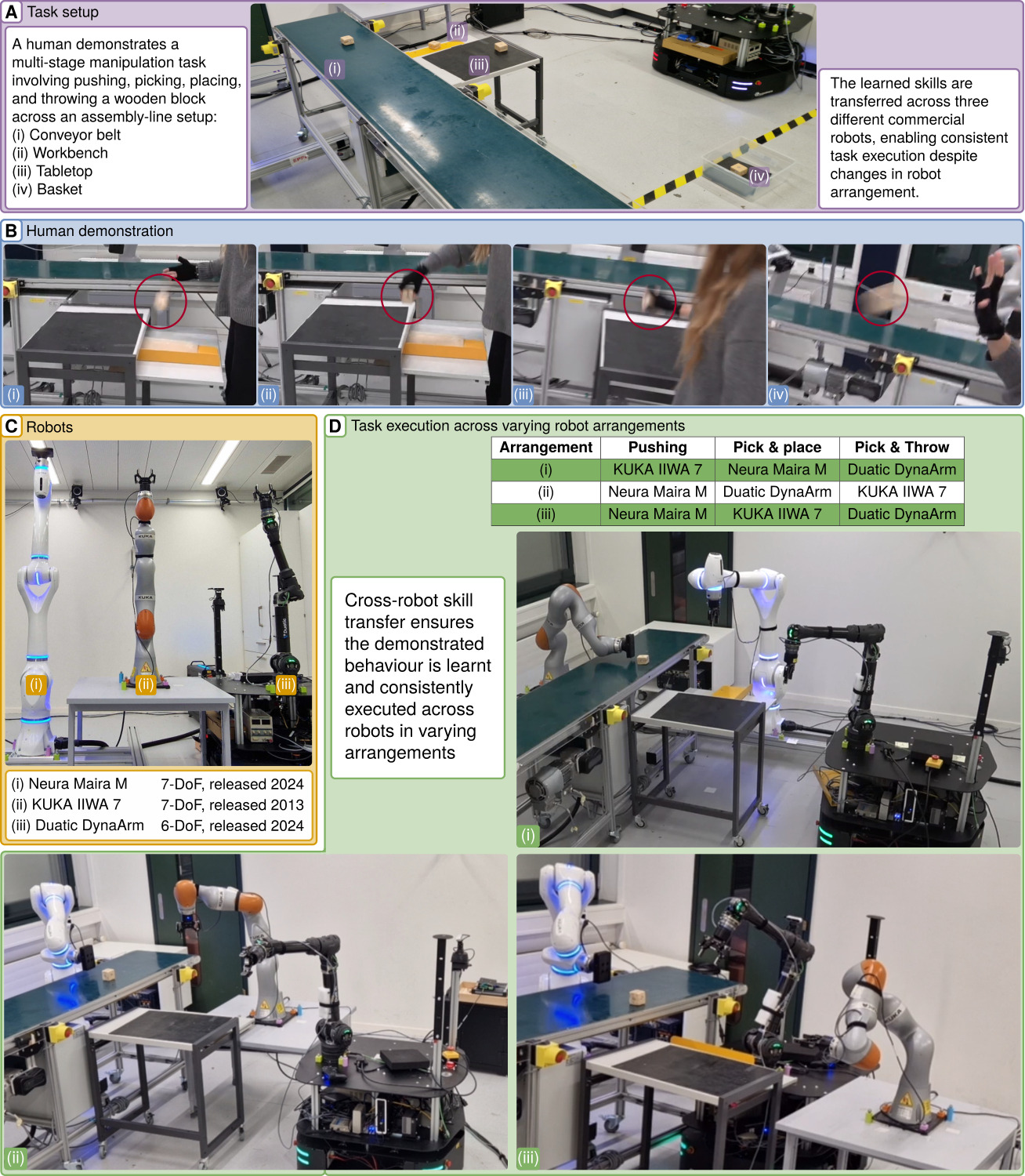
A multi-robot assembly-line experiment involving pushing, pick-and-place and throwing, with different assignments of robots to task stages.
An extension to cuspidal positional robots addresses multiple inverse-kinematic solutions within the same singularity-free aspect. My contribution includes the latent-space metric for mode selection and its integration with the controller.
The same demonstrated task stages are reused across different assignments of the robot platforms. Open the figure to inspect it at full size.
Scope & assumptions
The analytical guarantees concern the positional serial-robot structures and kinematic constraints represented by the framework. Environmental obstacles, self-collision, contact forces and general dynamic feasibility require complementary mechanisms.
@article{gupta2026kinematic,
  title = {Demonstrate once, execute on many: Kinematic intelligence for cross-robot skill transfer},
  author = {Sthithpragya Gupta and Durgesh H. Salunkhe and Aude Billard},
  journal = {Science Robotics},
  year = {2026},
  doi = {10.1126/scirobotics.aea1995}
}
@article{salunkhe2025cuspidal,
  title = {Cuspidal Redundant Robots: Classification of Infinitely Many IKS of Special Classes of 7R Robots},
  author = {Durgesh H. Salunkhe and Sthithpragya Gupta and Aude Billard},
  journal = {IEEE Robotics and Automation Letters},
  year = {2025},
  doi = {10.1109/LRA.2025.3623011}
}