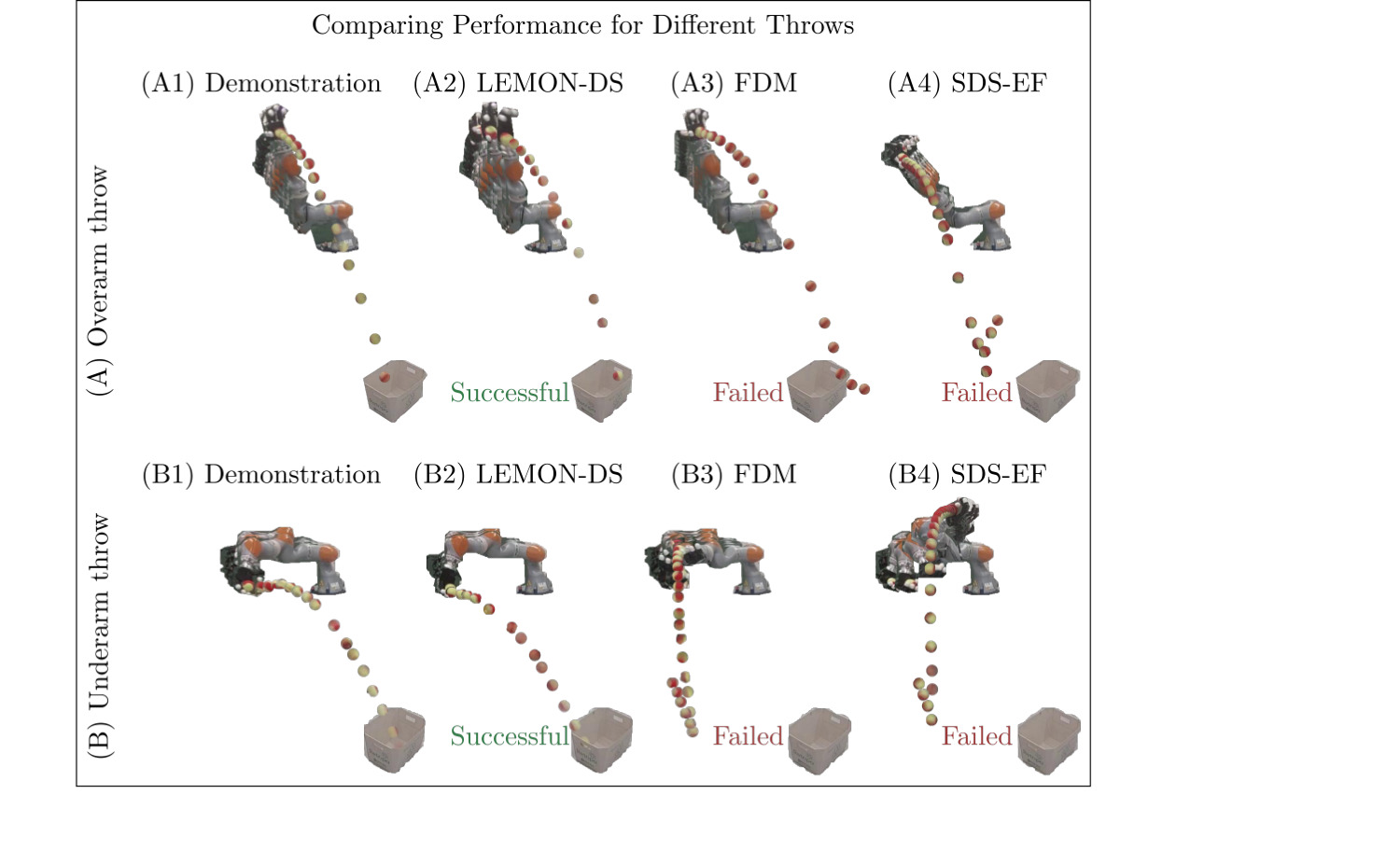
From a single high-dimensional demonstration to a compact, globally stable feedback policy.
Demonstration and reproduction in throwing experiments. The full comparison is reported in the LEMON-DS publication.
The question
A useful robot skill must do more than replay a recorded trajectory. It should respond to its current state, recover from perturbations and preserve the intended motion, even when only one demonstration is available.
The approach
LEMON-DS uses a graph-Laplacian embedding to reveal a structured latent representation of the demonstration. Stable dynamics are defined in this representation and mapped diffeomorphically into the execution space, producing a closed-form feedback policy.
Demonstration–behaviour interface
My contribution
I developed the first-order latent-space dynamical system following the graph-Laplacian embedding, the diffeomorphic learning of the corresponding robot policy, its analysis, and the experimental evaluation.
Results & evidence
Learning from a single demonstration, including high-dimensional robot behaviours with up to 23 dimensions.
Analytically established global asymptotic stability of the equivalent feedback policy under the formulation’s assumptions.
Experimental evaluation of behaviour reproduction and reactive execution, including robot throwing tasks.
Scope & assumptions
The formulation addresses point-to-point behaviour with one attractor. Multimodal or branching demonstrations, cycles, self-intersections and multiple stable goals are outside the current representation’s direct scope.
Why feedback matters
A feedback policy responds to the current state. Change the state during execution and the same policy can guide the motion back toward its goal.
Ready. Press Play to follow the policy.
Conceptual illustration using an analytically stable two-dimensional system and an invertible coordinate transformation. This is not a learned LEMON-DS policy or an experimental result.
@article{gupta2026lemon,
  title = {Compact One-Shot Modeling of High-Dimensional Demonstrations Using Laplacian Eigenmaps},
  author = {Sthithpragya Gupta and A. Nayak and Aude Billard},
  journal = {IEEE Transactions on Robotics},
  year = {2026},
  doi = {10.1109/TRO.2026.3666134}
}